Guide
Men's shirt sizes: the chart and the letters
A shirt label carries one number, and it measures one thing: the collar. Everything else — chest, shoulders, sleeves — was decided for you by whoever drew that size.
The chest column in this chart is a guide and not a rule: between one brand and another it shifts by as much as six centimetres. The collar, on the other hand, is the only column that is a real measurement and not a convention: it is the number itself.
The number on the label measures one thing only
On an Italian or European shirt the size is the circumference of the collar in centimetres. A 40 has a collar forty centimetres round: it is not a code, it is not a scale invented by the brand, it is a measurement taken with a tape.
There is nothing else inside that number. Not the chest, not the sleeve length, not the shoulders. Whoever made the size decided those three numbers for you, starting from the collar and from the average proportions of a man with a collar that size.
In the United Kingdom and the United States the same thing is measured in inches: the 40 becomes a 15 ¾. Half the confusion you find online comes from this — two charts measuring the same collar with two different rulers.
The chart, from 37 to 46
The first column is the size, that is the collar in centimetres. The second is the same collar in inches, as English and American shirtmakers write it. The third is the letter that size usually carries. The fourth is the body chest that size is cut for, in a regular fit.
| Size (collar in cm) | Inches | Letter | Body chest (cm) |
|---|---|---|---|
| 37 | 14 ½ | S | 84 – 88 |
| 38 | 15 | S | 88 – 92 |
| 39 | 15 ½ | M | 92 – 96 |
| 40 | 15 ¾ | M | 96 – 100 |
| 41 | 16 | L | 100 – 104 |
| 42 | 16 ½ | L | 104 – 108 |
| 43 | 17 | XL | 108 – 112 |
| 44 | 17 ½ | XL | 112 – 116 |
| 45 | 17 ¾ | XXL | 116 – 120 |
| 46 | 18 | XXL | 120 – 124 |
The letters do not mean the same thing in every country
The chart above follows the most widespread convention in Europe, the one used by German shirtmakers: 37 and 38 are an S, 39 and 40 an M, 41 and 42 an L, 43 and 44 an XL, 45 and 46 an XXL.
Many Italian brands shift everything by one size: for them S is 38 and 39, M is 40 and 41, L is 42 and 43, XL is 44 and 45. Same body, one letter apart — and that is why an XL fits in one shop and not in the other.
Hence the rule for buying online: the letter on its own is not enough. If the product page does not give the collar in centimetres, what you are reading is not a measurement but a label, and it changes from brand to brand.
Why two shirts of the same size fit differently
Because the number guarantees the collar and nothing else. Two shirts both marked 40, one cut slim and one cut comfortable, can differ by eight or ten centimetres across the chest: both are a 40, and both really are.
Then there is the sleeve. On ready-made shirts the sleeve length is tied to the size, because a size is a bundle of average proportions. A man with a 39 collar and long arms will have short sleeves in every shirt of his size, for ever: it is not a fault in those shirts, it is what a single number cannot carry with it.
How to find your size in two minutes
From a shirt that already fits you, which is the safest way: unbutton the collar, lay it flat and measure from the centre of the buttonhole to the centre of the button. The number you read in centimetres is your size.
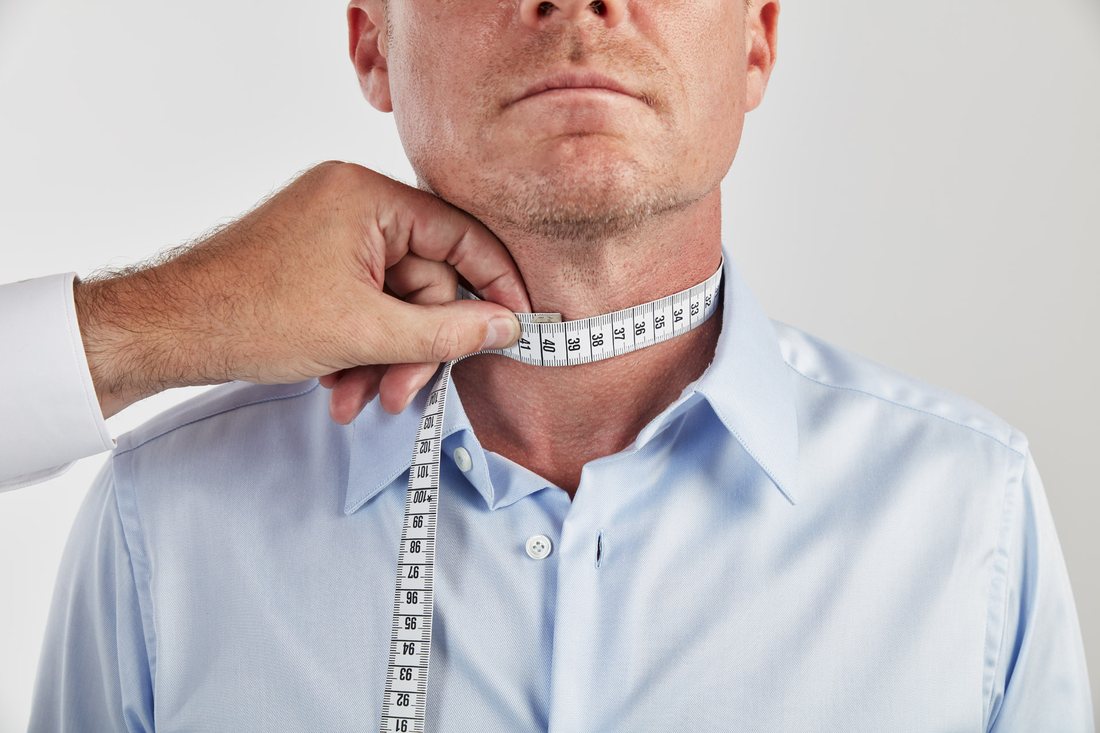
From the body, if you have no shirt that fits: the tape around the base of the neck, with one finger slipped between the tape and the skin. That finger is the room to breathe and to swallow, and without it the measurement comes out a centimetre too tight.
If you fall between two sizes, take the larger one. A collar a centimetre too tight is a nuisance all day and more of one after the first wash; a collar a centimetre too wide does not show under a tie.
If no size fits
A size is an average, and some people do not fit inside averages. A man with a 39 collar and a 104 chest, or wide shoulders and a narrow waist, will not find a number that works: that is not a difficult case, it is the ordinary case of someone who does not resemble the average.
Made to measure, the problem does not arise, because you do not choose a size: you give nine measurements and the pattern is adapted to them. The collar is the first of the nine, and it is taken exactly as above — the tape around the neck, one finger of ease.
So if you already know you wear a 40, write 40 in the collar field of the configurator: it is the same measurement, taken the same way. The other eight take ten minutes, and from there on the shirt is cut to your chest and not to the average chest of a man who wears a 40.
In the configurator you do not choose a size: you give nine measurements, and the collar is the first. If you know you wear a 40, write 40.
Design your shirt